Saturday, March 17, 2012

Peru - Fraser family pictures


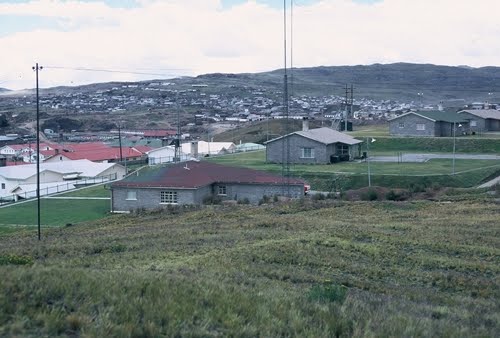
From the top: pic 1: Mountains near Cerro de Pasco. Pic 2: Allan Fraser's 10th birthday with faces I can remember: Karen Shadford, George Shadford, Tanya Visser, 1970. Pic 3: Cobriza mine circa 1970. Pic 4: Cerro camp circa 1971. Pic 5: Cobriza mine 1970. Pic 6: Miki Fraser, Sidney Fraser and Allan Fraser in the mountains near Casapalca, 1969.Pic 7: George Shadford,Allan Fraser, Brenden Shadford, Sidney Fraser, Casapalca at Rimac River. 1969. Pic 8: Our house in Casapalca 1969. All pictures by Robert Fraser. Pictures uploaded by Allan Fraser

Sunday, February 26, 2012

Pictures of Cerro de Pasco (early 1970s).


Photographs by Robert Fraser. Uploaded by Allan Fraser (Feb 2012).

Pictures of Cerro de Pasco (circa 1970)


Main road to Cerro de Pasco with view from Bellavista circa 1970. Picture by Robert Fraser

Cerro de Pasco (Bellavista), circa 1970. Picture by Robert Fraser

Sunday, March 14, 2010

A Tribute to the Peruvian Miner


Pictures: Peruvian miner on cover of the Serrano dated April 1973 and quartz and pyrite mineral specimen from a Peruvian mine. Posted by Allan Fraser 14 March 2010.

The Sleeping Miner
by Dennis Siluk
Oh yes, he has long gone now,
dispersed among the deep mines;
the one he sees, and remains
afloat throughout the night.
He sleeps on shimmering minerals-
his eyes have rapid movements.


No: 2082 12-4-2007

http://dennissiluk.tripod.com/

Tuesday, March 2, 2010

Cerro De Pasco


Here are a few pictures of our time in Cerro de Pasco with friends and family. Too many names I can't remember anymore. Allan Fraser, March 2010.
From top picture:
1. Paragsha Concentrator, Cerro De Pasco, 7 March, 1970
2. "Graduation Dinner" at Esperanza Club (?) June 1970. From front right: Miki Fraser, Mrs Visser, Mr. Visser, Tanya's sister (?), Tanya Visser, Gaby Cowper, then from front left; Sidney Fraser, Allan Fraser, George Shadford and Brendon (?) Shadford.
3. Yaupi Bajo; May 1972, left to right; Detto (?) Otega, Michelle Isaacs, Sidney Fraser, Allan Fraser, Fernando Otega, Jenny Isaacs.
4. Birthday party for Sidney Fraser; March 1972. Left to right; Jenny Isaacs, (?), Michele Isaacs, Soledad Garrate (?), Mrs Miki Fraser, (?), (David Kemp's sister?), Katherine Holthausen (?), ?, ?
5. Allan and Sidney Fraser with "Motta". In the garden of our house number 3, Cerro de Pasco. 1973


Cerro de Pasco

Sidney Fraser (left) and Allan Fraser. Near Cerro de Pasco, July 1971.

Sunday, February 15, 2009


This picture was taken at Ann Dixon's birthday party at our FCC house in Amachay. Paul Dixon is furthest right boy and Ann is holding Nesta our dog. Next to her is my other sister Jill who had a leg in plaster, but it doesn't show.

I recognise some of the people, such as Valerie and Julian Higgs as well as the Oueis but that is about it.

Al Heckle gave me this list of names:

Monica Williams, Nancy Ouei, Julian Hickford, Monica's sister??, Bruce Westby ??, Jim McKay, Bev Saunders, John Darcy behind Bev, Bonnie Hietzenroder, John McKay behind Bonnie, girl next to Bonnie (??), Randy Westby, you, next girl (??). Front row: Valerie Higgs, Jill, Ann, Ian Ouei.

I'd really love to get a full list if anyone can help.

Response to: Memories of the CdeP Mining Camps and Those I Remember

I haven't figured out how to respond to a post on this site so I am creating this new one.

To Margie (Nee Fawcett)

Read your blog with interest! Especially as you posted and referred to my picture of my family in front of the fireplace in the FCC house in Amachay and also posted the picture of my mother. (Actually the FCC houses were in a little area of Amachay called Tiapukio..... no idea how to spell it.)

You have to be daughter of Brian Fawcett.... is my guess who was engineer on FCC before we arrived. I have read his books and was always facinated by the storey of Colonel Fawcett his father.) He mentions the Chalaca railway coach in his story of the railways which we used when we were there.

With regard to the zigzags on the railway line. There was only one point at which the engine was removed and turned on a turntable and reconnect at the other end which was at San Bartolome about 75Km outside Lima. On all the other switchbacks they ware always a pair and the engine reversed the middle stretch between the points.

The really neat thing was that at Lima Station tourists always grabbed the seats facing the engine so that they could travel forwards all day. The savvy always picked the seats with backs to the engine as after an hour or so they would travelling forwards for the rest of the day.

Paul Dixon
paul (nospace) dixon 'at' mail dot com

Monday, January 5, 2009

Coincidences


That's Mum, my baby brother Michael and me behind the pram.


Nora Dixon’s house below is the house in the background in the picture on the right, the company car looks the same too…:)

Below, Me, Dad and Michael.


On an idle Sunday afternoon spent browsing through my Mother’s most dated albums, I found pictures of myself as a little boy two years old in La Oroya. This was October 1951, James and Josephina Stocks had occupied a house provided by the FCC with their children, Thomas and Michael. Dad was Assistant Traction Manager on the FCC, and the photos evoked one of the few memories I have of Oroya, that of Dad trying to cut my hair with hand operated clippers and me wishing I could go to the barber in town where there were electric clippers that never pulled hair and the mirrors made hundreds of me repeated for ever…

I image googled ‘Oroya 1955’ just fooling around, and found jamd.com had two photos, one of which my Mother recognized as being Chulec, where a lot of the Cerro de Pasco personnel lived, which was about a kilometre up the road towards Cerro de Pasco from where our house was. I opened Google earth, and lo and behold, Oroya is on and clear as a bell!

I googled ‘chulec’ and found this site (and the mention by Sylvia Walker!!) and several pictures of La Oroya taken around the time we were there, of special interest are the photos of Amachay in 1957 sent by Francoise Caudron, the pictures sent by Paul Dixon of the family posing in front of a fireplace and of Mrs Nora Dixon standing in front of her house (the house that contained the mentioned fireplace).


Looking at the Amachay site on Google Earth now and comparing it to Francoise’s photos you can see that all the houses on the other side of the road on Francoise's photo are gone, though you do see patches where they once stood. Mrs Nora Dixon’s house still stands though, a group of three houses lined up east-west, top right of the Google Earth picture, with a larger house (the semi-detached houses, 2 in 1) in the middle, Nora’s house is the west end house… Our house was the east side of the middle house (the semi-detached house),


Here's a photo of it in the distance taken from the entrance to Amachay at that time, when there was nothing but the two houses on it (the third most easterly house was built in 1952-53).

The other half of the semi-detached was occupied by the Kent’s. Mrs Kent spent a long time teaching by Mother English (Mum is Brazilian) using newspaper articles…


And the fireplace? Well, I have a photo of the Stocks’ and the Moore’s (whose fireplace it was back in ‘52/’53) lounging around the self same roaring hearth!!
We lived in Oroya from 1951 to 1953, when we moved down to Lima, first to Magdalena del Mar then later, to San Antonio, near Markham College where us kids went to school. In 1957 I suddenly had two more brothers, the twins Richard and Anthony... The Stocks' left Peru in 1965.

Sunday, October 12, 2008

Memories of the CdeP Mining Camps and Those I Remember


Margie Fawcett and Jennifer Fox, in Goyllarizquizca - 1952

Margie on the Andes pampas

Memories of my first couple of years in Goyllarizquizca where my first and best -- and now longest-standing -- friend was Jennifer Fox, daughter of Ken and Molly Fox (now in the United Kingdom), are followed by years in the Cerro de Pasco mining camps of Yauricocha, Siria, Mahr Tunel and, later, Cerro de Pasco proper. Here, in Cerro de Pasco, vivid Sunday scenes of “Wyatt Earp” and “Roy Rogers” – movies of the early 1950s -- appear, while we children, ranging in age from three to 14, were wrapped in awe in the comfortable theatre chairs of the Cerro de Pasco Club. The modern club, with all its amenities, was up the road from our house on the main road, facing the opposite hill with its two tiers of company houses. The clubhouse also offered a bowling alley and many a party was held there for our “partying” parents, including Bridge parties. Birthday parties were lots of fun in the grand dance hall. I remember the McComb, Humphreys, Patterson, Lochman, and Foote children -- some my age, some older.


My brother, Frank’s, and my house was right next door to the school. Although I was home-schooled until I was six or seven by my mother, given that the previous mining camps did not have schools, I think I attended the one in Cerro de Pasco only briefly, before we left for Colombia to another mining company, this time involved in gold mining one. Mother used to receive school material from Calvert Homeschooling in America.


Trips down to Lima, the capital, were broken by a stop at the company hotel in La Oroya (now the most polluted place on earth), where we visited some friends and family (Youngs (daughter Monica lives in Sydney, Australia), Allens, Oxleys, Fitchetts (daughter Ann lives in Christchurch, New Zealand), and Caudrons, respectively, the latter family now in Belgium). Relatives were also visited on our way through Casapalca – the Boswells (now in the United States).


Other children I remember from the different camps were (forgive spelling errors!) Doug Allen, the Smith-Gillespies (now in the United States and Switzerland), Gautiers, Nicoletti (or Nicolini?), and others who, in my mind, have now become nameless. Adults were the Oxleys, Whitlings, Walkers.


On the eight-hour trip to and from the coastal city of Lima, either by car or train, one would pass Ticlio at 18,000 feet altitude. “Soroche”, altitude sickness, was a common fact – we all suffered from it.


Train rides were captivating. While the Indian passengers would eat the strong-smelling large yellow fruit, relative to the lime, which were sold at the stations on long vines, we expatriates would be enraptured by the frequent change in direction of the train. The diesel engine, sometimes two at a time, which pulled the various carriages of peasants and city folk, would delink at one level, be turned on a “turn-about” and then push the train downwards to the next level of the high Andes mountains. On the next bend, the engine(s) would be turned around again to pull the coaches across and down the next few kilometers. The zigzagging, a feat of engineering, was the only way for the train to descend the high Andes mountains. What once was known as the Central Railway (built by an American, Henry (Enrique) Meiggs), is the highest railway in the world. The bridges across the deep valleys always held my breath. They were so narrow and high.


The loneliness and barren hills of the Andes, with the deep blue sky, is brought to mind many a time, when I listen to Peruvian Indian music, particularly when played with the kena and charango. It gives me a certain desire to be back there, but only for a while; to contemplate the harsh beauty enveloping a beige-brown-colored landscape, with snow-capped mountains and a deep blue cover that is the sky.

These are experiences and memories that have made us what we are today.


Margie (nee Fawcett)

Publish Post

RECONNAISSANCE

Pinning down the relevant people-points,
One contact leading to three, to fifteen, seventy ...
Is less the leisurely gathering of a bouquet
Than the grasping at leaves in a gale -
At that whirlwind mosaic of scattered lives -
In an effort to connect them to an original tree
When only the ghost of it remains.
But, seeking anew the comfort of those shadow-branches,
We grace them with the qualities of our metamorphosis.
Achievement and deadwood have added their layers
To the bilingual and carefree children
Who played against the backdrop of the Andes
And knew it later for a privileged kingdom.

Lark Burns Beltran

(Sent by Wilfredo Beltran)

(In Chulec 1953-56)